
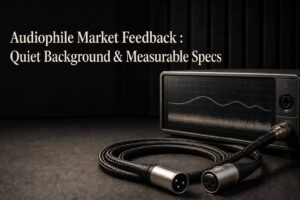
Piece together the scattered signals of the past year and the main line of hi-fi connectors becomes unusually clear: the conversation has shifted from storytelling to engineering. In the past, audiophiles discussed connectors mostly through brand narratives and vague descriptions of how they “sound.” Today, the parameters of materials, craft, and connection technology are increasingly transparent — OCC single-crystal copper has gone mainstream, CNC precision shells have become standard, and locking RCA and star-quad XLR are gaining heat. This is the shift Audiophile Connector Trends is built to document.
Together, these three forces lock the connector conversation into an engineering context that is “quantifiable, reproducible, and maintainable.” And that is exactly the core question Audiophile Connector Trends sets out to answer: once the parameters start speaking, purchasing and selection finally gain a reliable coordinate system.
1. Trend Summary
Read through the lens of Audiophile Connector Trends, this round of shifts is not the marketing copy of one or two vendors; it is the quiet consensus of the entire supply chain on “reliability, manufacturability, and maintainability.”
On the materials side, conductor purity and grain-boundary control have reached a new high; on the craft side, CNC and customizable plating have made “every unit is identical” a reality; and on the connection-technology side, mechanical locking and structural shielding have pushed the two most failure-prone links — “contact” and “noise” — into an engineering-controlled range.
Where these three forces converge, the connector in an audiophile’s hand is transforming from a “mystical accessory” into a “managed engineering component.”
For everyday users, this means two good things: first, selection no longer relies on guesswork, because you can judge by parameters like grain boundaries, plating, and shielding structure; second, long-term ownership cost drops, because stable contact and low failure rates make the system both quieter and more durable.
The rest of this report breaks that judgment into actionable detail. At this altitude, Audiophile Connector Trends is simply the collection of those parameters — grain boundaries, plating thickness, shielding layers — translated into a buyer’s checklist.
2. Professional Analysis: Three Trends (and One Underrated Dimension)
Breaking Audiophile Connector Trends down to the component level, we can split it into three main lines — materials, craft, and connection technology — plus one dimension that runs through all of them yet has long been underrated: batch consistency. Let us take them one by one.
1. Materials: Purity and Structure in Tandem
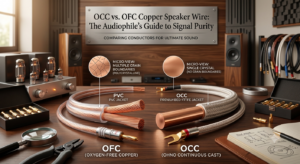
OCC (Ohno Continuous Cast) single-crystal copper eliminates grain boundaries through continuous casting, driving inter-crystalline scattering to an extreme low and, theoretically, offering the signal a “cleaner” conduction path. But it has never been a single-point winner in engineering — the value of single-crystal copper must work in concert with conductor geometry, terminal structure, insulation, and shielding before it can be heard.
This echoes the systems view represented by Pure Copper Speaker Cables: material is the base, not the whole story.
Beyond purity, the real dividing line is shifting toward structure: the stranding method determines high-frequency behavior under skin effect, the number of shielding layers determines how much external interference intrudes, and the dielectric constant of the insulating medium affects high-frequency phase. It is no longer enough to ask “is it single-crystal copper” — how material and structure cooperate is the keyword of the next stage. A pragmatic material-selection checklist looks roughly like this:
- Base-material path — prefer pure copper or high-conductivity alloys (e.g., tellurium copper) rather than judging by surface plating alone;
- Conductor geometry — stranding structure, wire gauge, and fill method determine high-frequency performance and mechanical flexibility;
- Shielding structure — single, double, or star-quad, which sets the noise floor;
- Plating only last — gold plating resists oxidation, rhodium plating wears hard; choose by usage frequency.
Taken together, these four points show how Audiophile Connector Trends turns a vague material claim into a reproducible sourcing request.
2. Craft: CNC and Customizable Plating
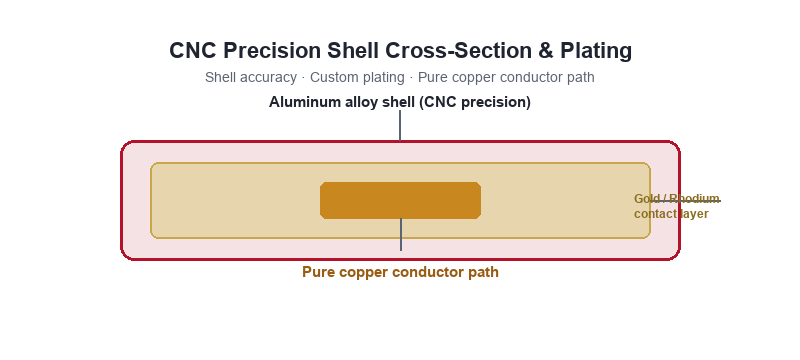
Precision shells guarantee pin concentricity and consistent insertion torque, so every connector “looks the same and performs the same.” This is the plainest yet most important layer of “engineering-first”: stable tolerance means batches are predictable, and integrators need not re-tune or re-test for every new lot.
Gold and rhodium plating can be customized by use case: gold is ductile with low initial contact resistance, suited to long-term fixed home connections; rhodium is hard-wearing and oxidation-resistant, suited to repeated rack-mount mating. We have broken down the trade-offs between the two in our article Gold or Rhodium Plating. A noteworthy new move is hybrid plating: applying composite layers such as silver+rhodium or copper+gold onto the copper conductor, so that the “signal path” and the “contact surface” each do their own job — decoupling conductivity from oxidation resistance and wear is a textbook example of “selection becoming rational.”
3. Connection Technology: Locking and Shielding
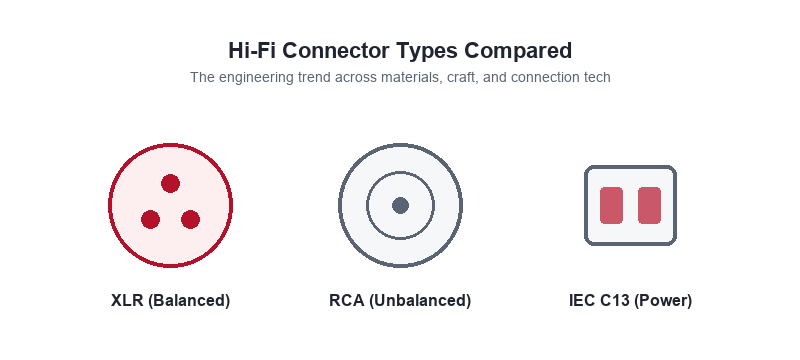
Progress at the connector level almost always lands on two engineering dimensions: “mechanical stability” and “electromagnetic cleanliness.” Locking RCA secures via thread or latch, solving the contact noise and dropouts that ordinary RCA suffers from — it relies on friction and loosens under long-term vibration or the weight of the cable; star-quad XLR makes the mutual inductance between adjacent conductors more uniform through its structure, canceling external electromagnetic interference more thoroughly and thus lowering the noise floor. Both moves are captured by Audiophile Connector Trends as part of the same engineering narrative: less mystique, more measurable structure.
4. The Underrated Dimension: Batch Consistency
In an “engineering-first” context, the most easily overlooked yet experience-defining factor is batch consistency. A beautifully spec’d sample is meaningless; what truly has value is the hundredth unit having the same pin concentricity, the same plating thickness, and the same contact resistance as the first. This requires suppliers to provide batch reports and RoHS/REACH compliance documents, and to stably control incoming materials and the manufacturing process. For DIY builders it means “my second box is the same as my first”; for integrators it means “field failure rate is predictable and after-sales cost is budgetable.” This is also why this report always places Rasantek-style engineering stability above any single-point parameter.
3. The Industry Signals Behind the Trends
Lifting the view from individual products to the supply chain, the visible signals point consistently to four keywords: reliability, distribution efficiency, sustainable manufacturing, and professional-grade connection solutions.
Reliability comes from the material and craft upgrades above; distribution efficiency requires suppliers to turn spec sheets, batch reports, and compliance documents into procurable standard parts rather than goods “left to chance.”
Sustainable manufacturing is shifting from a bonus to a threshold: halogen-free materials, recyclable shells, and more restrained plating chemistry respond to regulation and also lower long-term ownership risk. Professional-grade solutions mean connectors are increasingly organized by “application scenario” rather than “price tier” — home long-connection, professional high-frequency mating, and system-integration volume each have their corresponding structure and plating answer. Gather these signals together and the outline of Audiophile Connector Trends becomes complete: it is not the victory of one technology, but the entire chain becoming “professional” together.
| Trend dimension | Past (storytelling) | Now (engineering) |
|---|---|---|
| Materials | “OFC” / “single-crystal” slogans | OCC structure + stranding/shielding synergy, quantifiable |
| Craft | Large feel and appearance variance | CNC stable tolerance + customizable plating |
| Connection tech | Loose insertion, noise left to luck | Locking RCA + star-quad XLR, reproducible |
| Supply chain | Scattered goods, left to chance | Batch reports + compliance docs, manageable |
This comparison table is the miniature of how the trend moves from slogan to specification: every column change translates fuzzy “good sound” into verifiable engineering parameters.
One practical takeaway from these signals is to stop treating “premium” as a price tier and start treating it as a documented specification. When a supplier publishes conductor purity, plating thickness, shielding layers, and a batch report alongside the product, the buyer can compare like for like instead of trusting adjectives.
That shift is what turns a connector from a discretionary upgrade into a predictable engineering input — and it is the quiet reason professional integrators are standardizing on a short list of verifiable vendors rather than chasing the loudest marketing. It also rewards suppliers who invest in process control, because their consistency becomes a selling point no spec-sheet bluff can match.
Seen from the supply chain, Audiophile Connector Trends is therefore a trust signal: documented batches and disclosed tolerances matter more than any glossy brochure.
4. Long-Term Meaning for DIY Builders and System Integrators
Viewed through Audiophile Connector Trends, the long-term meaning is the same for both camps: the connector stops being a mysterious add-on and becomes a spec-able, serviceable part of the system. The paragraphs below split that meaning along the two audiences that feel it most.
For DIY Builders
The engineering-first trend gives DIY builders a more transparent selection coordinate system. When choosing DIY Hi-Fi Audio Plugs, we suggest re-ordering your priorities:
- Contact-material — prefer pure copper or high-conductivity alloys rather than judging by surface plating alone;
- Shell machining precision — CNC shell, pin concentricity, threaded locking structure;
- Soldering space and strain relief — avoid tension on the core and cold solder joints;
- Only then the label choice of “rhodium or gold,” decided by usage frequency.
Swappable-plug designs (swappable conductor / swappable plating) let builders tune tonality and control cost by system — this is the real long-term value of DIY. For the DIY builder, this is the most practical consequence of Audiophile Connector Trends: the hobby gains a professional backbone, and system tuning becomes a matter of components rather than folklore.
For DIY Builders
Integrators care more about batch consistency: the RCA and XLR in one project must hold stable insertion force, predictable contact resistance, and low failure rates. In commercial installations, “low noise, quantifiable, easy to maintain” matters far more than single-point listening impressions, so plating and structure choices must be evaluated against total cost of ownership (TCO).
Trading “listening impression” for “spec sheet” is the most practical dividend this round of trends hands to integrators. The two paths converge: connectors are moving from accessories to managed engineering components.
This precise engineering keeps RCA cables for audio free of ground loops and phase issues, delivering the pure analog magic that 2026 listeners still crave.
5. The Rasantek Audio Perspective
Rasantek Audio‘s product philosophy is almost the “standard answer” to this Audiophile Connector Trends report. While the industry still debates “storytelling or engineering,” Rasantek has already written the answer into the tolerance and plating of every connector:
- Red anodized aluminum CNC precision shell — mechanical precision guarantees pin concentricity and locking consistency;
- Customizable gold / rhodium surface treatment — the right plating for the use case (home long-connection / pro high-frequency mating), not uniform over-spec;
- Pure copper or high-conductivity base-material path — keep the signal path “pure” first, with plating as functional enhancement only;
- Batch-consistent and verifiable — spec sheets and batch reports support the integrator’s long-term operations.
Compared with brands that only sell mystical tonality, Rasantek is better positioned to win over DIY builders, audio brands, and system integrators simultaneously with “precision manufacturing + sonic purity + engineering stability.” To view the full connector and cable range, visit rasantekaudio.com.
Some FAQs
What is the most obvious trend in hi-fi connectors in 2026?
The main line is the shift from “storytelling” to “engineering”: on materials, OCC single-crystal copper has gone mainstream and works in synergy with structure; on craft, CNC precision shells and customizable plating have become standard; on connection technology, locking RCA and star-quad XLR are gaining heat; and on the supply chain, batch consistency and compliance are emphasized. Together they pull selection standards back from mysticism to quantifiable parameters.
Is OCC single-crystal copper really better than ordinary oxygen-free copper?
OCC lowers theoretical distortion by eliminating grain boundaries and is friendlier to signal transmission; but it is a “base,” not the whole story, and must work with stranding, terminals, and shielding. For most users OCC is a safe upgrade, but do not blindly pay a premium for the three words “single-crystal” — look at overall structure and system matching.
How should I choose between gold and rhodium plating?
Gold is ductile with low initial contact resistance, suited to long-term fixed home connections; rhodium is harder, more wear-resistant, and oxidation-resistant, suited to long-term rack mounting or professional high-frequency mating. Both are low-contact-resistance solutions; the difference is mainly in lifespan and use case — see our article Gold or Rhodium Plating.
Is the difference between locking RCA and ordinary RCA significant?
The difference is in mechanical stability: ordinary RCA relies on friction and loosens under long-term vibration or cable weight, bringing contact noise and dropouts; locking RCA secures via thread or latch, keeping contact consistent. For fixed placements, especially floor-standing gear, the improvement is audible and quantifiable.
Why does star-quad XLR buy a quieter background?
The star-quad structure makes the mutual inductance between adjacent conductors more uniform, canceling external electromagnetic interference more thoroughly and thus lowering the noise floor. When shielding upgrades from “is there any” to “how many layers, and how is it twisted,” the quietness of the background gains a measurable difference.
How should system integrators turn these trends into a procurement standard?
Trade “listening impression” for “spec sheet”: lock in suppliers whose pin tolerance, plating thickness, shielding structure, and batch consistency are verifiable, and require batch reports and RoHS/REACH compliance documents. The value of the engineering-first trend ultimately shows up as lower field failure rates and after-sales costs.
Conclusion
The main line of hi-fi connectors is the shift from storytelling to engineering; the engineering-first era across materials, craft, and connection technology has fully arrived. Once parameters start speaking, selection no longer relies on guesswork, but on a reproducible, maintainable coordinate system.
Around Audiophile Connector Trends , Rasantek Audio insists on supporting the long-term needs of DIY builders and system integrators with “CNC precision shells + customizable gold/rhodium + batch-consistent conductors.” To view the full product and customization range, visit the Rasantek Audio website.
Ready to experience the surge? Power up with Rasantekaudio’s premium RCA cables for audio today and hear the explosive difference in every note.
Dive deeper with these Rasantekaudio resources:
Don’t wait — grab your RCA cables for audio from Rasantekaudio now and feel the explosive difference!


 EN
 DE
 ES
 FR
 IT
 JA
 RU
 PT
 ZH_CN