

Piece together the scattered signals from the past year’s shows and forums and the main line of Audiophile Market Feedback becomes unusually clear: the conversation has shifted from “expensive equals good” to “quiet background plus measurable specs.” Enthusiasts no longer accept a connector on the strength of a brand story; they ask about contact resistance, shielding effectiveness, and mating-cycle life. That is the shift this report is built to document.
Together, these three forces — a quieter background, verifiable parameters, and trust in long-term reliability — lock connector discussion into an engineering context that is “quantifiable, reproducible, and maintainable.” And that is exactly the core question this report sets out to answer: once the parameters start speaking, purchasing and selection finally gain a reliable coordinate system. Read this way, Audiophile Market Feedback becomes a framework rather than a mood board: a shared vocabulary for comparing connectors across brands without falling back on adjectives.
Table of Contents
1. Market Feedback Summary
Read through the lens of Audiophile Market Feedback, this round of listener signals is not the marketing copy of one or two vendors; it is the quiet consensus of the entire community on “reliability, transparency, and value.” Across show floors and forums alike, the demands converge on three points: a blacker background, specs you can actually read, and a connector that still works a decade later.
On the listening side, “background quietness” has overtaken raw tonal color as the thing people chase; on the buying side, A/B listening and parameter comparison have gone mainstream, so vendors are forced to state conductor, plating, and geometry as verifiable numbers; and on the ownership side, reliability is being re-priced — buyers now pay for “plugs in for ten years without oxidizing or loosening” rather than for a pretty story. Where these three forces converge, the connector in an enthusiast’s hand is transforming from a “mystical accessory” into a “managed engineering component.”
For everyday users, this means two good things: first, selection no longer relies on guesswork, because you can judge by parameters like contact resistance, shielding layers, and mating-cycle rating; second, long-term ownership cost drops, because stable contact and low failure rates make the system both quieter and more durable. The rest of this report breaks that judgment into actionable detail. At this altitude, the feedback is simply those parameters — contact resistance, shielding, plating thickness — translated into a buyer’s checklist.
2. Professional Analysis: Three Signals (and One Underrated Shift)
Breaking Audiophile Market Feedback down to the component level, we can split it into three main signals — quiet background, measurable specs, and re-priced reliability — plus one shift that runs through all of them yet is often missed: a younger, value-driven audience. Let us take them one by one.
1. Quiet Background = Lower System Noise
What enthusiasts call a “black background” is, in engineering terms, a lower system noise floor — and it is the real problem that Balanced XLR Cable shielding and star-quad geometry actually solve. A cleaner shield and a more uniform conductor layout do not add “warmth”; they remove the hum, the hash, and the low-level grain that sit between you and the recording. This is why feedback keeps circling back to shielding structure rather than to marketing adjectives. That quietness is exactly what Audiophile Cables keeps demanding.
2. Measurable = Reproducible
The rise of A/B blind testing and spec-sheet comparison is a sign the market is maturing. When a vendor states conductor purity, plating thickness, and shielding layers as numbers, two listeners in two rooms can finally converge on the same conclusion instead of talking past each other. Within this feedback, “measurable” has become the precondition for “trustworthy”: a claim you cannot reproduce is a claim you should not pay for.
- Contact resistance — the lower and more stable, the less signal is lost at the joint;
- Shielding effectiveness — single, double, or star-quad, which sets the noise floor;
- Mating-cycle rating — how many insertions before contact force drifts;
- Plating only last — gold resists oxidation, rhodium wears hard; choose by usage.
Taken together, these four numbers show how the feedback turns a vague “it sounds better” into a reproducible sourcing request a buyer can hand to a supplier.
3. Reliability Is Being Re-Priced
A decade ago, enthusiasts paid for a “tonal story.” Today they pay for “plugs in for ten years without oxidizing or coming loose.” That is a fundamental re-pricing: durability and batch consistency have moved from footnote to headline. It rewards suppliers who invest in process control, because their consistency becomes a selling point no spec-sheet bluff can match.
4. The Underrated Shift: A Younger, Value-Driven Audience
The signal most vendors still under-read is demographic. Multiple 2025 show reports note the audience is getting younger, and that affordable, three-digit-price gear drew bigger crowds than ever. Streaming, headphones, and desktop rigs pulled a new generation in, and they arrive expecting transparency and value, not mystique. For connector brands, that means the old “price equals prestige” playbook is losing its grip — the next decade of this feedback will be written by buyers who ask for the datasheet before the brochure.
3. The Industry Signals Behind the Feedback
Lifting the view from individual posts to the market, the visible signals point consistently to four keywords: quiet background, measurable specs, reliability, and accessibility. Quiet background comes from the shielding and geometry upgrades above; measurable specs require vendors to publish conductor, plating, and shielding data rather than adjectives; reliability comes from CNC consistency and batch reporting; and accessibility is the younger, value-driven crowd refusing to pay prestige premiums for unspecified gear.
Sustainable and transparent manufacturing is shifting from a bonus to a threshold: halogen-free materials, recyclable shells, and restrained plating chemistry answer both regulation and buyer skepticism. Professional-grade solutions mean connectors are increasingly organized by “application scenario” rather than “price tier” — home long-connection, pro high-frequency mating, and system-integration volume each get their own structure and plating answer. Gather these signals together and the outline of Audiophile Market Feedback becomes complete: it is not the victory of one technology, but the entire chain becoming “professional” together.
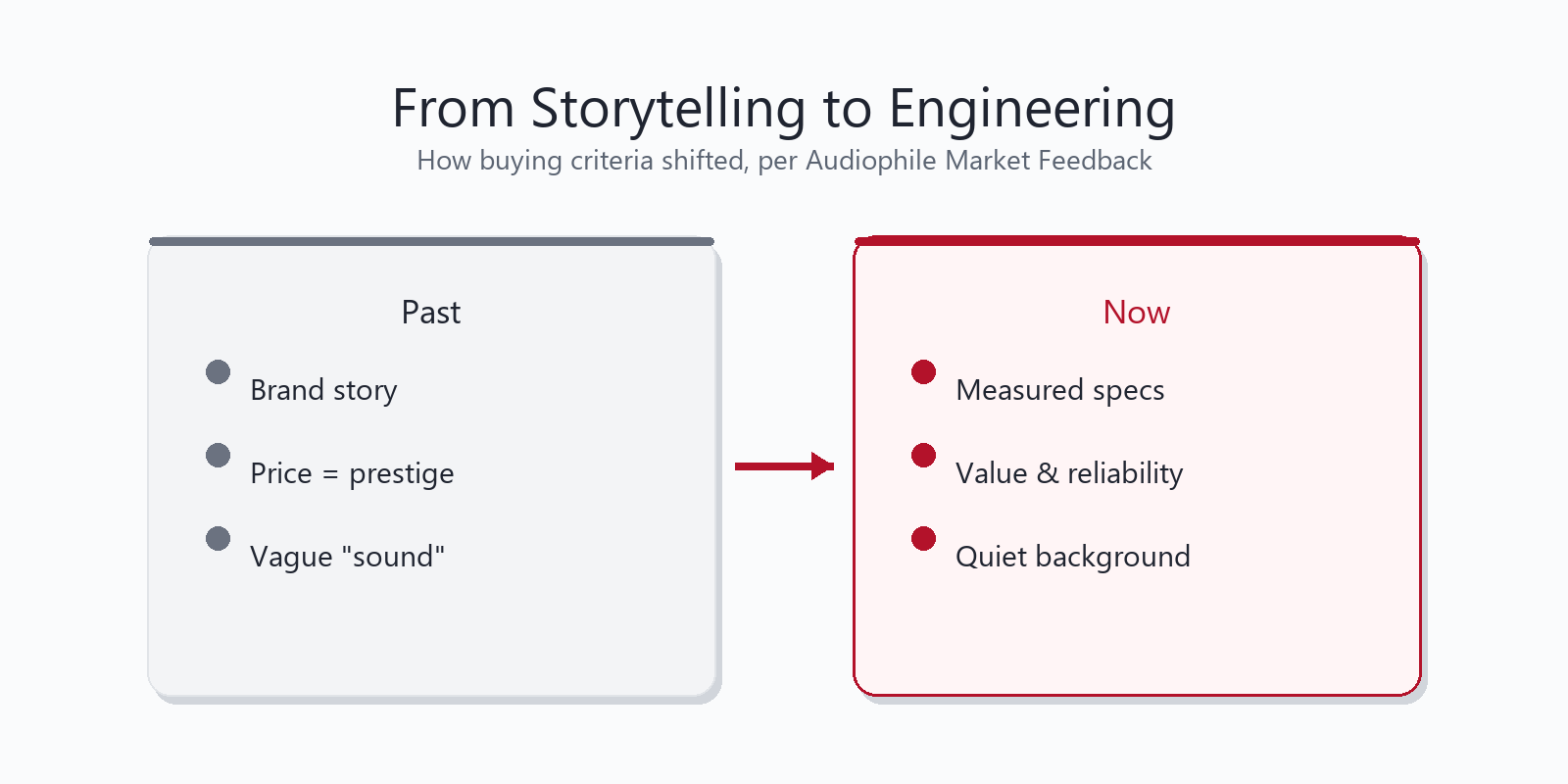
| Feedback dimension | Past (storytelling) | Now (engineering) |
|---|---|---|
| Background | “musical,” “airy” adjectives | Lower noise floor, measurable shielding |
| Specs | Buried or absent | Contact resistance, plating, geometry stated |
| Reliability | Story of craftsmanship | Batch reports, mating-cycle ratings |
| Audience | Prestige-driven少数 | Younger, value-driven, datasheet-first |
This comparison table is the miniature of how the feedback moves from slogan to specification: every column change translates fuzzy “good sound” into verifiable engineering parameters.
One practical takeaway from these signals is to stop treating “premium” as a price tier and start treating it as a documented specification. When a supplier publishes conductor purity, plating thickness, shielding layers, and a batch report alongside the product, the buyer can compare like for like instead of trusting adjectives. That shift is what turns a connector from a discretionary upgrade into a predictable engineering input — and it is the quiet reason professional integrators are standardizing on a short list of verifiable vendors. Seen from the supply chain, Audiophile Market Feedback is therefore a trust signal: documented batches and disclosed tolerances matter more than any glossy brochure.
4. Long-Term Meaning for DIY Builders and System Integrators
Viewed through Audiophile Market Feedback, the long-term meaning is the same for both camps: the connector stops being a mysterious add-on and becomes a spec-able, serviceable part of the system. The paragraphs below split that meaning along the two audiences that feel it most.
For DIY Builders
The engineering-first trend gives DIY builders a more transparent selection coordinate system. When choosing RCA Connector for Audiophiles, we suggest re-ordering your priorities around what the feedback actually rewards:
- Contact-material — prefer pure copper or high-conductivity alloys rather than judging by surface plating alone;
- Shell machining precision — CNC shell, pin concentricity, threaded locking structure;
- Soldering space and strain relief — avoid tension on the core and cold solder joints;
- Only then the label choice of “rhodium or gold,” decided by usage frequency.
Swappable-plug designs (swappable conductor / swappable plating) let builders tune tonality and control cost by system — this is the real long-term value of DIY. For the DIY builder, this is the most practical consequence of the feedback: the hobby gains a professional backbone, and system tuning becomes a matter of components rather than folklore.
For System Integrators
Integrators care more about batch consistency: the RCA and XLR in one project must hold stable insertion force, predictable contact resistance, and low failure rates. In commercial installations, “low noise, quantifiable, easy to maintain” matters far more than single-point listening impressions, so plating and structure choices must be evaluated against total cost of ownership (TCO).
Trading “listening impression” for “spec sheet” is the most practical dividend this round of feedback hands to integrators. The two paths converge: connectors are moving from accessories to managed engineering components.
For the DIY builder, the dividend shows up as fewer ruined evenings: a connector with stable pin concentricity and a reliable strain-relief seats the first time, holds its solder joint, and does not introduce a mysterious intermittent hum two weeks later. For the integrator, the same discipline shows up on the P&L — predictable contact resistance and low field-failure rates turn after-sales from a cost center into a managed line item. Neither audience needs to become a metallurgist; both simply benefit from a market that has started speaking in numbers instead of stories, where a documented batch is worth more than a handsome brochure.
5. The Rasantek Audio Perspective
Rasantek Audio‘s product philosophy is almost the “standard answer” to this Audiophile Market Feedback report. While the industry still debates “storytelling or engineering,” Rasantek has already written the answer into the tolerance and plating of every connector:
- Red anodized aluminum CNC precision shell — mechanical precision guarantees pin concentricity and locking consistency;
- Customizable gold / rhodium surface treatment — the right plating for the use case (home long-connection / pro high-frequency mating), not uniform over-spec;
- Pure copper or high-conductivity base-material path — keep the signal path “pure” first, with plating as functional enhancement only;
- Batch-consistent and verifiable — spec sheets and batch reports support the integrator’s long-term operations.
Compared with brands that only sell mystical tonality, Rasantek is better positioned to win over DIY builders, audio brands, and system integrators simultaneously with “precision manufacturing + sonic purity + engineering stability.” To view the full connector and cable range, visit rasantekaudio.com.

Some FAQs
What is the biggest shift in audiophile market feedback for 2026?
The main line is the move from “expensive equals good” to “quiet background plus measurable specs.” Enthusiasts now ask about contact resistance, shielding effectiveness, and mating-cycle life instead of trusting a brand story, and reliability is being re-priced as a headline feature rather than a footnote.
Why does "quiet background" matter more than tonal color now?
A black background is, in engineering terms, a lower system noise floor — the ceiling on everything you hear. Better shielding and a more uniform conductor layout remove hum and low-level grain, which listeners now rank above vague claims of “musicality.” That is why feedback keeps returning to shielding structure.
What specs should I actually look at on a connector?
Start with four numbers: contact resistance (lower and more stable is better), shielding effectiveness (single, double, or star-quad sets the noise floor), mating-cycle rating (insertions before contact force drifts), and plating thickness. A vendor that states these is one you can compare like for like.
Is gold or rhodium plating better, given the new feedback?
Neither is universally “better” — the feedback rewards choosing by use case. Gold is ductile with low initial contact resistance, suited to long-term fixed home connections; rhodium is harder, wear-resistant, and oxidation-resistant, suited to rack mounting or pro high-frequency mating. Both are low-contact-resistance solutions; the difference is lifespan and application.
How should system integrators turn this feedback into a procurement standard?
Trade “listening impression” for “spec sheet”: lock in suppliers whose pin tolerance, plating thickness, shielding structure, and batch consistency are verifiable, and require batch reports and RoHS/REACH compliance documents. The value of the engineering-first trend shows up as lower field failure rates and after-sales costs.
Why does the younger, value-driven audience change the game?
Multiple 2025 show reports note the audience is getting younger, with affordable three-digit gear drawing bigger crowds than ever. That generation arrives expecting transparency and value, not mystique — so the old “price equals prestige” playbook is losing grip, and the next decade of feedback will be written by buyers who ask for the datasheet before the brochure.
Conclusion
The main line of audiophile market feedback in 2026 is the shift from storytelling to engineering: a quieter background, verifiable specs, and re-priced reliability have fully arrived. Once parameters start speaking, selection no longer relies on guesswork, but on a reproducible, maintainable coordinate system.
Around these connector trends, Rasantek Audio’s answer to Audiophile Market Feedback insists on supporting the long-term needs of DIY builders and system integrators with “CNC precision shells + customizable gold/rhodium + batch-consistent conductors.” To view the full product and customization range, visit the Rasantek Audio website.
If this Audiophile Market Feedback has you wanting to DIY your own audio cables or you can’t find the right audio cable wire brand, I hope the following articles can help you:


 EN
 DE
 ES
 FR
 IT
 JA
 RU
 PT
 ZH_CN