

Strip away the marketing and the real question about Audiophile Power Cable purity is simple: which part of the cable actually changes the electrical environment your gear sees? Spend a week reading measurement forums, manufacturer spec sheets, and installer reports and the answer stops being mystical.
Conductor material, shielding, and connector plating each play a role — but they do not play it equally, and two of the three are far more measurable than the third. That is the line this guide is built to draw.
Table of Contents
1. Audiophile Power Cable: Purity Summary
Read through the lens of Audiophile Power Cable purity, the signals from measurement communities and integrator forums converge on one honest point: the cable is not magic, but it is also not irrelevant. The variables that survive scrutiny are conductor resistance, shielding effectiveness, and connector contact stability.
The variables that mostly survive on expectation are exotic crystal structures and burn-in narratives. Where these separate, the cable in your hand turns from a mystery spool into a managed engineering component.
Viewed through Audiophile Power Cable, on the conductor side, purity (4N/5N OFC, OCC) lowers resistance at the margin; on the noise side, braided-plus-foil shielding is what actually keeps RFI out of a DAC; and on the ownership side, gold or rhodium plating plus a copper alloy base is what keeps the contact low-resistance for years.
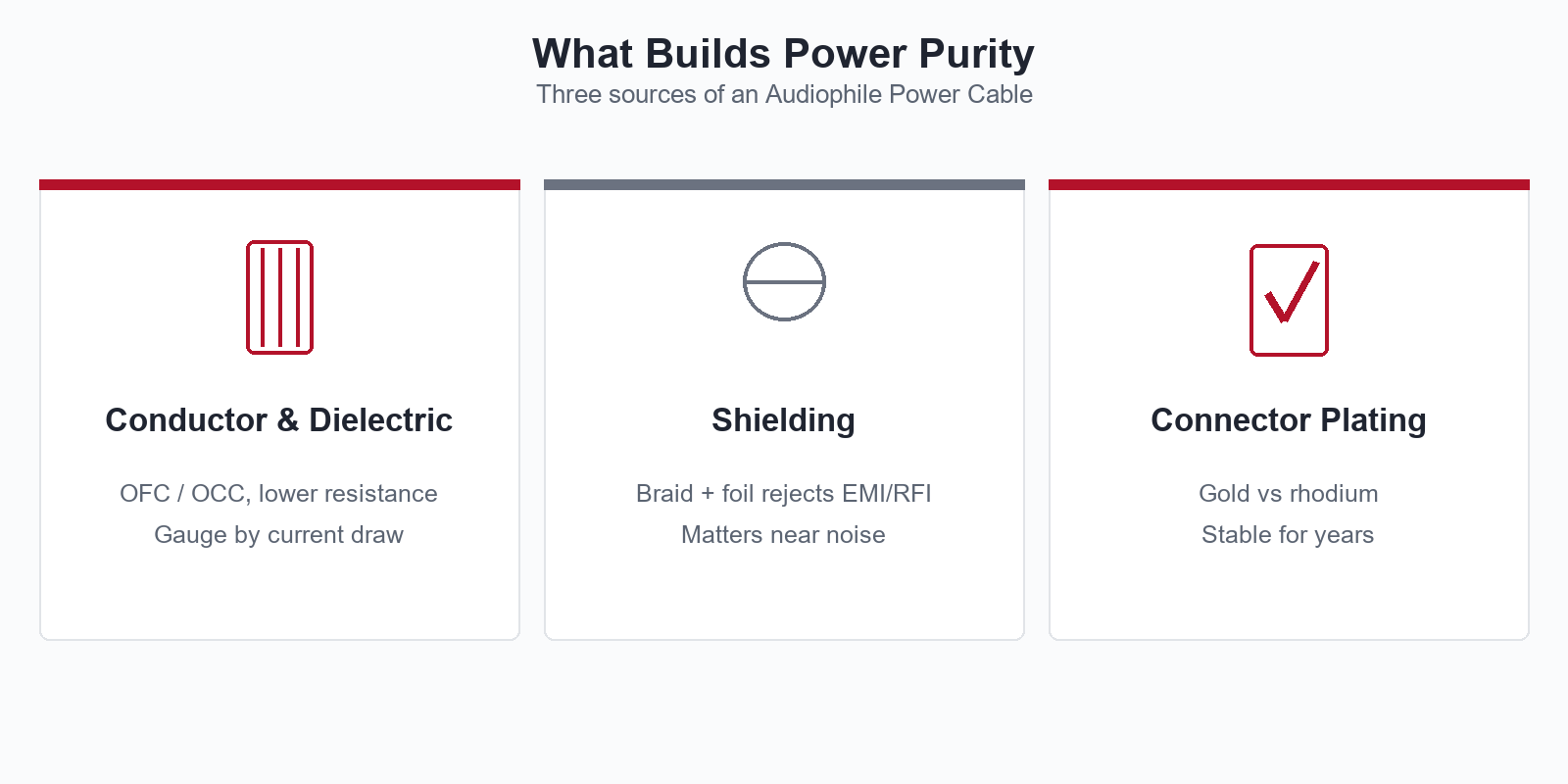
Three forces, three different weights — and only the last two move the noise floor you can measure. For everyday buyers this means two good things: first, selection no longer relies on guesswork, because you can specify by material, shield, and connector; second, long-term cost drops, because a cable that seats firmly and resists oxidation fails less often. The rest of this guide breaks that judgment into actionable detail.
2. Audiophile Power Cable: Three Sources of Purity
Breaking Audiophile Power Cable purity down to the component level, we can split it into three main factors — conductor and dielectric, shielding, and connector plating — plus one dimension that runs through all of them yet is most often missed: the gap between measurement and expectation. Let us take them one by one.
1. Conductor & Dielectric Set the Baseline
High-purity copper (OFC at 4N/5N, or Ohno Continuous Cast OCC) reduces internal resistance and grain-boundary scattering, and a low-dielectric insulator (polyethylene, Teflon) reduces capacitive charge/discharge noise. The logic is the same one behind Audiophile Connector Trends — only here the object is current, not signal.
What matters for AC delivery is resistance and gauge: a thicker conductor (lower AWG) holds voltage under current peaks, so a power amplifier wants 10–12 AWG while a DAC or streamer is fine on 14–16 AWG. Purity helps, but for 50/60 Hz AC the conductivity gap between OFC and OCC is small compared with the dominance of shielding.
2. Shielding Isolates External Noise
A power cable runs next to routers, LED drivers, motors, and switching supplies — all of which pump electromagnetic and radio-frequency interference onto the mains. A multi-layer shield (braided copper plus aluminum foil, optionally with ferrite) stops that noise from riding into sensitive circuitry.
This is the same shielding philosophy behind Audiophile Cables, just applied to AC instead of signal. For source components — DACs, streamers, phono stages — shielding is the single most defensible reason to upgrade a power cord, because those boxes process the lowest-level signals and are most exposed to mains noise.
- EMI source — motors, dimmers, and switch-mode supplies near the rack;
- RFI source — Wi-Fi, cell towers, and wireless transmitters;
- Shield structure — braid, foil, or star-quad, which sets rejection;
- Ground strategy — floating vs tied shield ends, which can avoid loops.
Taken together, these four points show how Audiophile Power Cable turns a vague “it sounds cleaner” into a reproducible sourcing request a buyer can hand to a supplier: name the shield, name the gauge, name the connector.
3. Connector Plating Decides Long-Term Stability
The IEC C13/C19 plug and the wall plug sit under constant line voltage and are the points most likely to oxidize or loosen. Gold plating resists oxidation; rhodium plating resists wear from frequent mating — the exact trade-off covered in our Audiophile Connector Trends piece.
A copper-alloy base under the plating conducts better than steel, and high contact pressure keeps resistance stable through thermal cycling. A power cable is only as good as its weakest seat: a beautiful conductor behind a flimsy, oxidizing connector still hums intermittently two weeks later.
4. The Underrated Dimension: Measurement vs Expectation
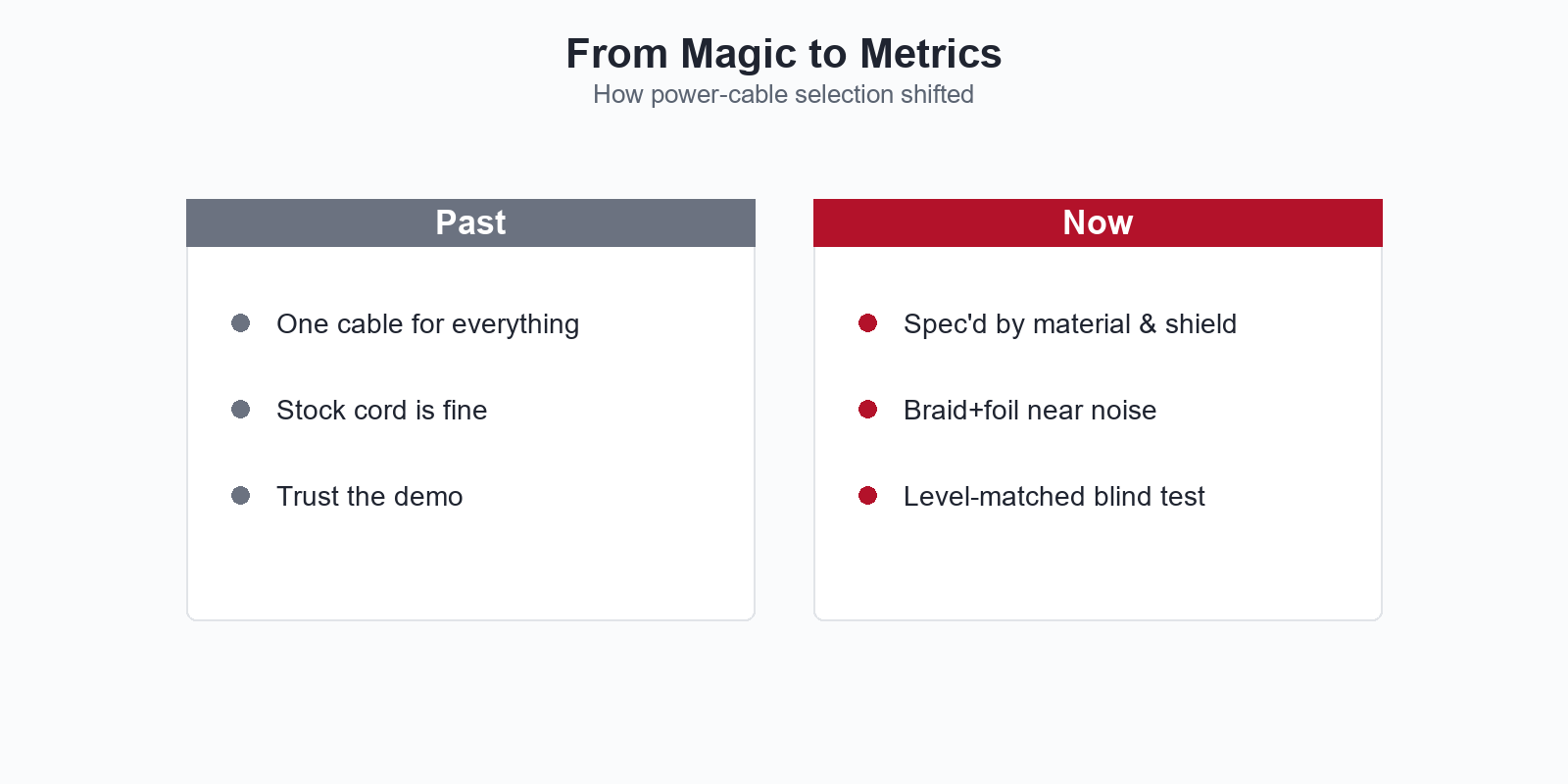
The factor most marketing still under-reads is honesty about what is audible. Independent measurement communities such as AudioScienceReview are clear: a power cable can differ measurably in shielding, impedance, and contact resistance, but conductivity and “crystal structure” are not meaningful factors for 50/60 Hz AC delivery, and many reported differences shrink to nothing under level-matched blind testing.
That is not a reason to feel cheated — it is a reason to spend on the parts that measurably help (shield, gauge, connector) and stop paying for the parts that mostly help the story. For an Audiophile Power Cable, the disciplined buyer treats expectation as a variable to control, not a feature to purchase.
3. The Industry Signals Behind Audiophile Power Cable
Lifting the view from one component to the market, the visible signals point consistently to four keywords: purity, shielding, plating, and honesty about measurement.
Purity shows up as 4N/5N OFC and OCC marketing; shielding shows up as braid-plus-foil constructions in every premium cord; plating shows up as the gold-vs-rhodium debate moving from connectors to power contacts; and honesty shows up as measurement communities such as SoundStage! pushing back on burn-in and crystal-structure claims.
Sustainable and transparent manufacturing is shifting from a bonus to a threshold: halogen-free jackets, recyclable materials, and restrained plating chemistry answer both regulation and buyer skepticism.
Gather these signals together and the outline of the modern Audiophile Power Cable becomes complete: it is not the victory of one exotic material, but the whole category becoming “professional” together — documented, specified, and modest about its claims.
| Factor | Myth (story) | Metric (spec) |
|---|---|---|
| Conductor | “OCC single-crystal magically betters sound” | Purity lowers resistance marginally; small vs shielding at 50/60 Hz |
| Shielding | “The stock cord is fine” | Braid + foil rejects EMI/RFI; matters near routers and motors |
| Connector | “Any plug will do” | Gold = oxidation resist, rhodium = wear; copper base + pressure matter |
| Gauge | “Longer cable = better” | AWG by current: 10–12 AWG amp, 14–16 AWG source; controls drop |
| Proof | “Trust the demo” | Level-matched blind test; measure the noise floor |
This comparison table is the miniature of how Audiophile Power Cable moves from slogan to specification: every column change translates fuzzy “good cable” into verifiable engineering parameters.
One practical takeaway from these signals is to stop treating “premium” as a price tier and start treating it as a documented specification. When a supplier publishes conductor purity, shielding structure, current rating, and connector plating alongside the cable, the buyer can compare like for like instead of trusting adjectives.
That shift is what turns a cable from a discretionary line item into a predictable engineering input — and it is the quiet reason serious listeners are standardizing on a short list of verifiable vendors. Seen from the supply chain, a documented cable is therefore a trust signal: disclosed ratings matter more than any glossy brochure.
4. Audiophile Power Cable: Long-Term Meaning for DIY Builders & Integrators
Viewed through Audiophile Power Cable, the long-term meaning is the same for both camps: the cable stops being a mysterious spool and becomes a spec-able, serviceable part of the system. The paragraphs below split that meaning along the two audiences that feel it most.
For DIY Builders
The engineering-first trend gives DIY builders a more transparent selection coordinate system. When building or choosing a power cord, we suggest re-ordering your priorities around what the spec actually rewards:
- Current first — name the component’s draw, then pick AWG (10–12 for amps, 14–16 for sources);
- Shielding second — pick braid-plus-foil for any run near noise sources;
- Connector precision — copper-alloy base, gold or rhodium plate, secure seat;
- Only then the material label of “OCC or OFC,” decided by budget, not myth.
Swappable IEC connectors let builders tune cost and plating by system — this is the real long-term value of DIY. For the DIY builder, the most practical consequence of the engineering-first shift is freedom from folklore: the hobby gains a professional backbone, and power selection becomes a matter of components rather than superstition.
For System Integrators
From the standpoint of Audiophile Power Cable, integrators care more about batch consistency: every box on a project must hold stable contact resistance, correct gauge, and low field-failure rates. In commercial and residential installs, “low noise, code-compliant, easy to maintain” matters far more than single-point listening impressions, so cable and connector choices must be evaluated against total cost of ownership (TCO).
Keeping audio power separate from building mains, using shielded cords near racks, and specifying IEC connectors with verified plating are all auditable engineering actions — not taste. Trading “listening impression” for “spec sheet” is the most practical dividend this round of market feedback hands to integrators.
5. The Rasantek Audio Perspective on Audiophile Power Cable
Rasantek Audio‘s product philosophy is almost the “standard answer” to this Audiophile Power Cable report. While the industry still debates “storytelling or engineering,” Rasantek has already written the answer into the tolerance and plating of every connector and cable assembly:
- High-purity copper path — OFC/OCC base material keeps the supply path “pure” first, with plating as functional enhancement only;
- Multi-layer shielding — braided plus foil construction to reject mains EMI/RFI near sensitive sources;
- Customizable gold / rhodium surface treatment — the right plating for the use case (home long-connection / pro high-frequency mating), not uniform over-spec;
- Batch-consistent and verifiable — spec sheets and batch reports support the integrator’s long-term operations.
Compared with brands that only sell mystical tonality, Rasantek is better positioned to win over audiophiles, audio brands, and system integrators simultaneously with “precision manufacturing + supply purity + engineering stability.” To view the full connector and cable range, visit rasantekaudio.com.
Some FAQs
Does an Audiophile Power Cable actually change the sound?
It can change the electrical environment your gear sees, but not always in ways you hear. Shielding, gauge, and connector quality measurably affect noise rejection, voltage drop, and contact stability — and those help most on sensitive source components like DACs and streamers. Exotic conductor “crystal structure” has little measurable effect on 50/60 Hz AC. Under level-matched blind testing, many reported differences shrink dramatically, so spend on the parts that spec out, not the parts that sound poetic.
Is OCC copper worth it over OFC for a power cable?
OCC (Ohno Continuous Cast) reduces grain boundaries and is a real manufacturing upgrade, but for AC power delivery its conductivity edge over 4N/5N OFC is small compared with the impact of shielding and connector quality. If your budget is limited, put the money into a better shield and a copper-alloy, well-plated IEC connector before chasing OCC. See our Audiophile Connector Trends note for the same purity logic on the signal side.
What AWG gauge should I use for an audiophile power cable?
Match gauge to current draw. Power amplifiers and subwoofers benefit from 10–12 AWG to avoid voltage drop on peaks; source components such as DACs, streamers, and preamps are well served by 14–16 AWG. Thicker is not automatically better — an overbuilt cord can stress a lightweight component’s IEC inlet and is harder to route. Buy the length you need with a little service allowance, not excess coil.
Gold or rhodium plating on the power connector — which?
Gold resists oxidation, so it is ideal for home gear that stays plugged in for years. Rhodium resists wear from frequent mating, so it suits pro and demo environments with constant plugging. Both beat nickel or bare steel. The base metal matters too: a copper-alloy base conducts better than steel under the plating. This is the same trade-off we cover in IEC C13 Power Connector.
How much shielding does a power cable need?
Enough to match your electrical environment. In a quiet, dedicated-circuit home, a basic braid may suffice. Near Wi-Fi, LED drivers, motors, or dense racks, choose braid-plus-foil (and consider ferrite) to reject EMI/RFI. More shielding can slightly raise capacitance and, if grounded incorrectly, invite ground loops — so match the shield strategy to the install rather than maximizing it blindly.
Should I buy a power conditioner or just a better cable?
They solve different problems. A conditioner filters noise and adds surge protection for multiple components; a cable mainly affects the run it sits on. The efficient order is: first clean power at the wall (dedicated circuit, surge protection), then a quality shielded cable on your most sensitive source, then a conditioner only if you have a diagnosed noise problem. A premium cord is rarely the first tool that moves the needle.
Conclusion
The main line of Audiophile Power Cable purity in 2026 is the shift from storytelling to engineering: conductor purity, multi-layer shielding, and documented connector plating have fully arrived, while crystal-structure mysticism is being pushed back by measurement. Once parameters start speaking, selection no longer relies on guesswork, but on a reproducible, maintainable coordinate system.
Around these cable trends, Rasantek Audio insists on supporting the long-term needs of audiophiles, audio brands, and system integrators with “high-purity copper path + multi-layer shielding + customizable gold/rhodium connectors.” To view the full product and customization range, visit the Rasantek Audio website.
If you want to specify your own cables or can’t find the right power cord brand, I hope the following articles can help you:


 EN
 DE
 ES
 FR
 IT
 JA
 RU
 PT
 ZH_CN